

What It May Be Doing to Your Skin, Hair, and Even Your Lungs (And Why It Matters More Than You Think)
Most people think of their shower as one of the healthiest parts of their day.
It’s where you cleanse your body, relax your mind, and wash away the stress of the day.
But what if that daily ritual is quietly working against your skin, your hair, and even your respiratory system?
Because here’s something very few people realize: the water coming out of your shower should be just as clean as the water you drink (yet rarely is).
Your Skin Is Not Just a Barrier. It’s an Active Interface
 Your skin is your body’s largest organ, and it is far more interactive than most people realize. It doesn’t simply block everything out. It exchanges, absorbs, and responds to what it encounters.
During a warm or hot shower, several things happen at once. Your pores open, circulation increases, and the outermost layer of your skin becomes more permeable. At the same time, you are exposed to disinfectants like chlorine and to disinfection byproducts that can form when chlorine interacts with organic matter in water.
Scientific research confirms that exposure to these compounds does not occur through drinking alone. In fact, studies on water disinfection byproducts show that humans are exposed through multiple pathways, including dermal absorption and inhalation during everyday activities like showering and bathing.
What Chlorine Exposure May Be Doing to Your Skin
Chlorine plays an essential role in keeping public water supplies safe from harmful microbes. However, its effects on the skin are a different story.
Chlorine is a strong oxidizing agent, and oxidation is one of the core processes associated with visible aging. When skin is repeatedly exposed to chlorinated water, it can interfere with the skin’s natural balance.
A controlled dermatological study found that even relatively low levels of residual chlorine in bathing water significantly reduced the water-holding capacity of the skin’s outer layer (the stratum corneum), particularly in individuals with sensitive skin. In simple terms, this means the skin became less able to retain moisture after exposure.
This helps explain why many people experience tightness, dryness, or irritation after showering. It’s not just a cosmetic issue. It reflects a change in how the skin is functioning.
Over time, repeated disruption of the skin barrier may contribute to the visible appearance of dryness, uneven tone, and reduced smoothness. And importantly, when the skin barrier is compromised, even high-quality skincare products may not perform as effectively as they otherwise could.
If your skin has ever felt tight, dry, or slightly irritated right after a shower, there’s a good chance you’ve already experienced this firsthand.
The Often-Ignored Effects on Hair and Scalp
 Your hair and scalp are exposed to the same environment, and they respond in similar ways.
Chlorine can interact with the proteins that give hair its structure, including keratin. This interaction can contribute to dryness, reduced shine, and increased brittleness over time. Dermatology experts frequently note that chlorine exposure strips natural oils from both the skin and hair, leading to dryness and a rougher texture.
In addition, minerals commonly found in tap water can leave behind residue on the hair shaft. This buildup can interfere with moisture absorption and leave hair feeling heavy or difficult to manage.
Many people attempt to solve this with conditioners, masks, or styling products. But if the underlying exposure continues every day, these solutions often address symptoms rather than root causes.
What Happens When You Breathe in Your Shower
 This is one of the most overlooked aspects of shower exposure.
When hot water turns into steam, volatile compounds in the water, like chlorine and certain byproducts, can evaporate into the air. This creates an inhalation pathway that many people never consider.
Research has demonstrated that during a typical shower, measurable levels of chloroform (a common disinfection byproduct) can be detected in breath after exposure, confirming that inhalation is a significant route of uptake.
Other studies examining exposure pathways have found that inhalation and skin absorption together can account for a substantial portion of total exposure to these compounds during showering.
This matters because chlorine is known to be irritating to the respiratory tract. Health authorities note that chlorine exposure can affect the eyes, skin, and airways, potentially leading to irritation of the nose, throat, and lungs.
While the levels encountered in everyday showering are far lower than those in industrial exposure scenarios, the risk becomes more sizeable when you consider how often most of us shower. This is not a one-time event. It is a daily exposure that accumulates over time.
Why Are These Chemicals in Your Shower Water in the First Place?
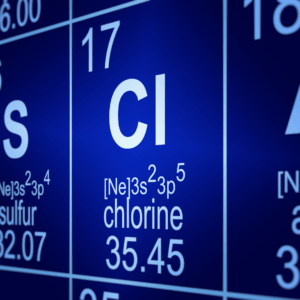 For over a century, water systems have used disinfectants like chlorine to kill harmful bacteria and pathogens. And to be clear, this has played a major role in reducing infectious diseases and making water safer to drink.
However, chlorine doesn’t just disappear after it disinfects water. It remains present as “residual chlorine” as water travels through pipes and into your home. And along the way, it can react with organic matter to form disinfection byproducts, such as trihalomethanes, including chloroform.
Research has shown that exposure to these byproducts doesn’t just occur through drinking water. It also happens through skin contact and inhalation during activities like showering, which are often overlooked exposure pathways.
And in recent years, many municipalities have shifted from chlorine to something called chloramine, a compound formed by combining chlorine with ammonia.
Why? Because chloramine is more stable. It lasts longer in the water system, but that stability comes with a tradeoff.
Chloramine is significantly harder to remove than chlorine, and it can persist all the way to your showerhead. Today, it’s estimated that over 30% of U.S. water systems use chloramine instead of free chlorine, a number that has steadily increased over time and continues to grow.
And again, when you take a hot shower, these compounds don’t just stay in the water.
They can vaporize into the air, creating an inhalation pathway. Studies measuring chloroform exposure have shown that levels in the body increase after a typical shower, confirming that what’s in your water doesn’t just stay on your skin. It can enter your body through multiple routes.
So while water treatment has become more effective at controlling microbes, it has also created a new category of daily exposures that most people have never been taught to think about.
So even if you’ve been careful about drinking filtered water, you may still be getting daily exposure from a source most people never think about: your shower.
The Compounding Effect of Daily Exposure
If you shower once per day, that’s over 350 exposures per year. Twice per day brings that number to more than 700. Over the course of decades, this becomes a consistent and repeated interaction between your body and your environment.
Scientific literature on water disinfection byproducts emphasizes that exposure is not limited to ingestion but occurs repeatedly through skin contact and inhalation in daily activities like bathing.
And when small exposures are repeated consistently over time, their impact may become more meaningful than a single, larger exposure.
Why This Matters More Than Most People Realize
Most people focus heavily on what they put on their skin and in their body, but very few people consider what their skin is exposed to before any of those products are applied.
It’s a bit like trying to improve your diet while consistently smoking cigarettes. You can still make progress, but it’s slower and often less effective than it could be.
Once you understand that your shower represents a daily combination of skin, hair, and inhalation exposure, it becomes clear that it is a foundational part of your environment.
A More Foundational Way to Think About It
Instead of constantly trying to counteract the effects of your environment, a more effective approach is often to improve the environment itself.
That’s where filtering your shower water comes in.
By reducing common contaminants like chlorine at the point of contact, you can create a more supportive daily experience for your skin, your hair, and even the air you breathe during your shower.
And unlike many other health or beauty interventions, this doesn’t require adding more steps to your routine. It simply enhances something you already do every day.
AquaTru Shower Head: A Simple Upgrade That Can Transform Your Shower
 So the question becomes: what can you actually do about it?
An easy solution to protect yourself is to use a shower filter; however, not all shower filters are created equal.
Many standard filters are designed to reduce chlorine, but struggle to effectively remove chloramine, which is now used in a growing percentage of U.S. water systems.
AquaTru is specifically engineered to address both.
Its multi-stage filtration system is designed to reduce not just chlorine but also chloramine, helping improve the quality of your water in a way many conventional filters simply can’t. And that distinction matters more than most people realize.
One of the reasons AquaTru has become so popular is how simple it is to use.
It’s designed to fit standard U.S. shower connections, so installation typically takes just a few minutes with no special tools required.
Once installed, you can choose from multiple stream settings, whether you prefer a gentle mist, a massage setting, or a more powerful, high-pressure rinse.
And when it’s time to replace the filter, the twist-lock design makes it quick and easy.