

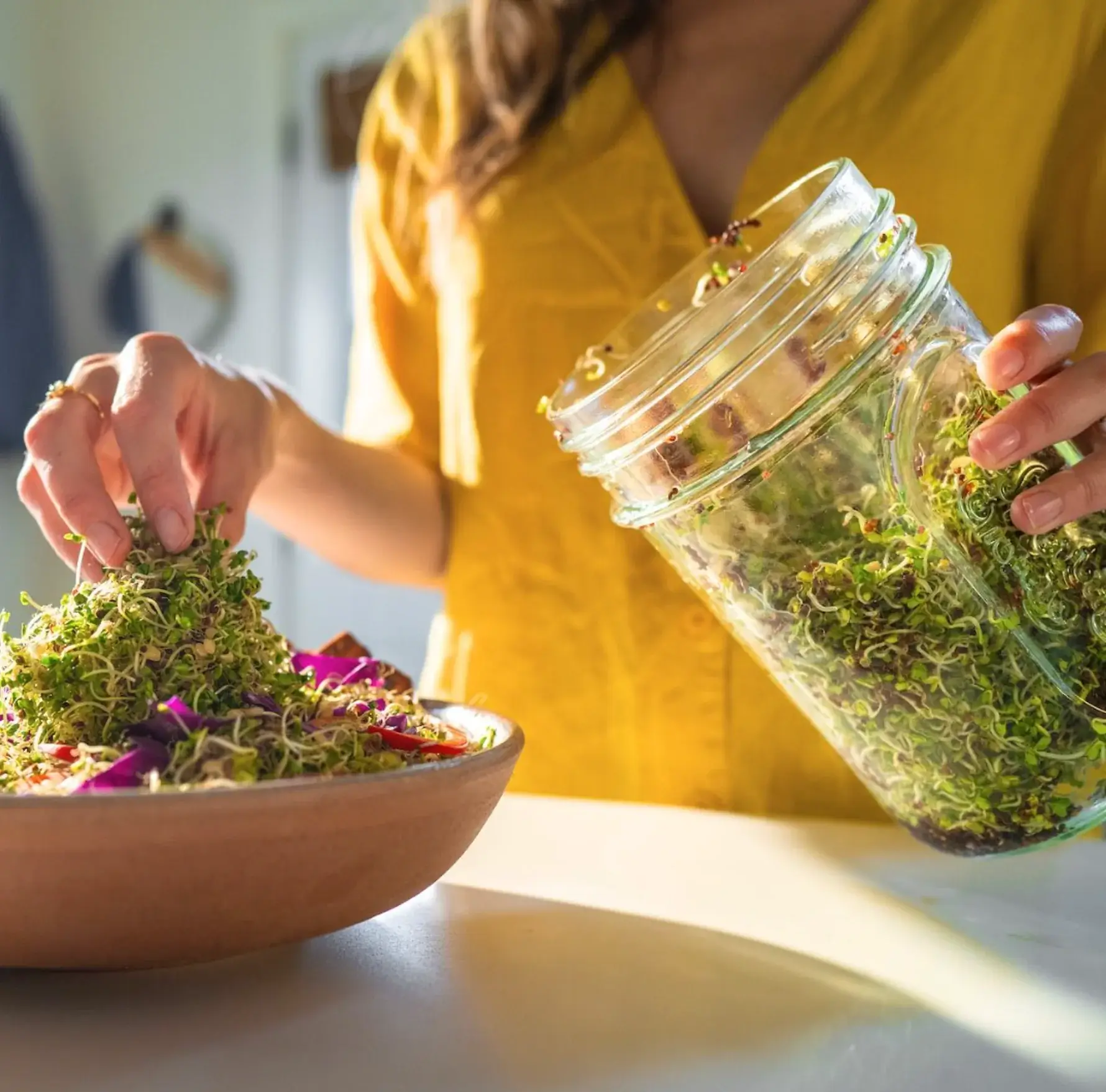
There’s a food so powerful that researchers have spent more than 25 years studying it.
It’s not exotic, it’s not expensive, and you can grow it yourself with roughly the daily effort it takes to make a cup of coffee.
It’s the humble broccoli sprout. And once you understand what’s actually happening inside those tiny green threads, you may never look at your countertop the same way again.
First, let’s talk about why your cells age in the first place
 Every single day, your cells are under attack.
Sunlight, pollution, stress, processed food, and even the simple act of breathing all generate unstable molecules called free radicals.
Left unchecked, that “oxidative stress” is one of the great drivers of how quickly we age, on the inside and on the outside.
Here’s the good news, and it’s a big one.
Your body was built with its own defense system. A kind of internal switch that, when flipped, tells your cells to ramp up their natural protective machinery.
Scientists call that switch Nrf2.
Think of it like the master breaker in your home’s electrical panel. Flip it, and dozens of downstream protections light up at once.
The question researchers have been chasing for decades is simple: what flips it best?
Meet nature’s most powerful “switch flipper”
The answer, it turns out, may be a compound with an unglamorous name: sulforaphane.
Of all the natural compounds studied so far, sulforaphane is considered one of the most potent Nrf2 activators found in nature.
In other words, it’s one of the best-known “switch flippers” on the planet, and it comes from cruciferous vegetables (broccoli, cauliflower, cabbage, and their cousins).
But here’s where it gets interesting for anyone who cares about aging well.
The mature broccoli in your produce aisle contains only a modest amount of sulforaphane’s precursor.
The young sprout contains dramatically more.
Why the sprout beats the vegetable (this is the whole ballgame)
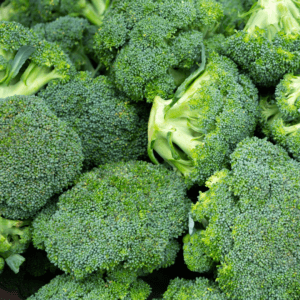 This is the part almost nobody knows.
A three-day-old broccoli sprout can contain many times more of sulforaphane’s precursor than the full-grown vegetable, the compound your body converts into that master-switch-flipping sulforaphane.
Some of the most-cited research on this suggests the difference can be enormous, gram for gram, which means a small jar of sprouts may deliver what would otherwise take pounds of cooked broccoli.
There’s a catch, though.
Sulforaphane is fragile. It’s created when the plant is chewed, chopped, or damaged, and it’s at its peak when the sprout is fresh and alive, hours from harvest, with its enzymes still intact.
Cooking degrades it. Long shipping and shelf time degrade it. And most stores don’t even carry fresh broccoli sprouts, because they’re too perishable to sit around.
So the single most powerful way to get sulforaphane isn’t to buy it. It’s to grow it and eat it fresh.
What 25+ years of research point to
 Now, a quick and important note before we go further.
I am not claiming a sprout is a cure for anything, and you should be skeptical of anyone who does.
But the body of research on sulforaphane is genuinely remarkable for a compound you can grow in a jar. Here’s what scientists have been exploring.
Your cellular defenses. Sulforaphane has been shown to switch on the Nrf2 pathway and support the body’s own antioxidant and inflammatory-balance systems, the exact machinery that helps your cells hold up against everyday oxidative stress.
Healthy glucose metabolism. Sulforaphane from broccoli sprout extract has been studied for its effect on fasting blood sugar, with some trials showing modest improvements. This is an area of active, ongoing research into healthy metabolism.
Your skin and how it holds up to the sun. In one well-known study, an extract of broccoli sprouts applied to human skin reduced UV-triggered redness and inflammation by an average of 37%. Notably, it wasn’t working like a sunscreen sitting on top of the skin. It appeared to boost the skin’s own protective enzymes from the inside, an intriguing angle for anyone focused on the appearance of aging skin.
That last one matters, because so much of how “old” we look comes down to sun and oxidative damage over the years.
How to grow your own broccoli sprouts (it really is this simple)
Here’s the whole process, start to finish. If you can rinse a colander, you can do this.
What you’ll need: a tablespoon or two of broccoli sprouting seeds, clean water, a container that drains well, and about 60 seconds of attention, twice a day.
Day 0 — Soak. In the evening, rinse your seeds, then cover them with cool water and let them soak overnight, about 6 to 8 hours. This wakes the seeds up and tells them it’s time to grow.
Day 1 — Drain and rinse. Pour off the soaking water, give the seeds a good rinse, and then drain them thoroughly. This is the single most important habit in the entire process, so let me say it plainly: standing water is the enemy. Trapped moisture is what turns a promising batch into a slimy, musty disappointment. You want your seeds damp, never sitting in a puddle. Set them somewhere at room temperature and out of direct sun.
Days 2 through 4 — Rinse, drain, repeat. Twice a day, morning and night, rinse the sprouts with cool water and drain them completely. That’s the entire job. You’ll watch tiny white tails appear, then stretch, then start to crowd the container. It feels a little like magic the first time.
Day 4 or 5 — Give them light. Once your sprouts are tall and lush with pale yellow leaves, move them into indirect light for a few hours. The leaves will green up as they develop chlorophyll. This step is purely cosmetic, so don’t stress over it, but the deep green does look beautiful.
 Day 5 — Harvest fresh. Give them one last rinse, drain them as dry as you can, and they’re ready. Eat them within a day or two of harvest, while they’re at their freshest and most alive, because as you now know, freshness is the whole point when it comes to sulforaphane. Toss them on a salad, blend them into a smoothie, or pile them onto avocado toast. Store the rest in the fridge.
Now, the honest part.
You can absolutely do all of this with a mason jar and a piece of screen. People have for generations. But here’s where good intentions tend to fall apart, and it’s worth knowing before you start:
- Drainage makes or breaks it. A jar tipped at an angle traps water at the bottom, and that’s precisely where slime and mold get their foothold. Getting a jar to drain completely is fussier than it sounds.
- The twice-a-day rinse only works if you remember it. A sprouter shoved in a cabinet is a sprouter you forget by day three. Out of sight really is out of mind, and the whole batch pays for it.
- What touches your food matters. If you’re growing your own food specifically to control what goes into your body, a plastic lid and a rubber band aren’t exactly the finish you were hoping for.
None of these are dealbreakers. They’re just the reasons so many people try sprouting once, end up with a jar of disappointment, and never go back.
The good news is that every one of these problems has already been solved for you.
My Top Recommendation: The Sprouting Company’s Starter Kit
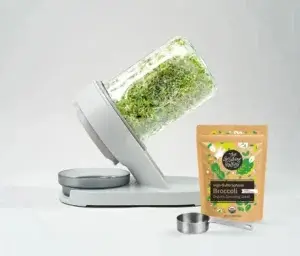 This is why I want to put The Sprouting Company’s Starter Kit on your radar.
It’s a proper, purpose-built sprouting system, and it was designed specifically to fix everything that used to make people give up.
Here’s why it stands out.
It’s as easy as making coffee. Add a scoop of seeds, soak overnight, then rinse and drain twice a day. In five days, a quarter cup of seeds becomes about five cups of fresh sprouts. That’s roughly seven servings from a single little harvest.
The design solves the mason-jar problem. The straight walls ensure 100% drainage, so no more trapped water or slime. A stainless steel filter replaces the fussy screens and plastic lids. It’s one clean system that actually works, every time.
Nothing but glass and steel touches your food. No plastic ever meets what you’re growing, and the whole thing is dishwasher-safe. For folks who grow their own food precisely because they want to know exactly what’s in it, that peace of mind is the point.
It’s built to live on your counter. This sounds minor. It isn’t. A gadget you tuck in a cabinet is a gadget you forget, and the habit disappears with it. This one is beautiful enough to leave out, which is exactly what keeps the daily rinse from slipping.
And The Sprouting Company backs the whole thing with a Grow Easy Guarantee. You’ll go seed-to-plate in 5 days, or they’ll make it right within 30 days, plus a 1-year warranty on the sprouter itself.
In other words, there’s nothing to lose but a little counter space.
👉 Start Growing Today with up to 25% Off Your Starter Kit, plus FREE shipping
PLUS, just for The Art of Anti-Aging audience, you can use coupon code: AAA today for 10% off. This only applies to one-time products and not subscriptions.
I’ve been sprouting a variety of seeds for over 30yrs. Soo yummy and delicious!
Go on and treat yourself!
My daughter has this.
Nice. I love to sprout and have done it for years. You are correct in your article for all the ways it could go wrong, been there, done that.
It is important to have a great system of broccoli and vegetables for dinner!
Thank you. The article explains a more comprehensive information on the benefits of the broccoli sprouts than I thought I already knew. I do enjoy all your articles. They go that one step further providing detailed information.
I would loved to have purchased The Growing Company Starter Kit. Unfortunately, I live in Australia. They do not deliver.
Excellent timing!
I had a Caprese Salad the other day with fresh mozzarella and cherry tomatoes, dressed with reduced balsamic vinegar and topped with beautiful, little basil sprouts. I think it’s time to invest in 2 sprouters so I can have some broccoli and some basil any given day. I had forgotten how much I love sprouts and how gratifying it is to grow your own. Thank you!
Absolutely brilliant Thank you so much ! I’m on the case !
I really appreciate all of this good information on broccoli sprouts as well as the step by step guide on how to sprout them. I’ve wondered about how to do this, and even tried once only to have the sprouts turn out moldy and brown. It’s such a simple process but it really helps to have it explained as you have done here. Thanks so much. I’ll get started soon!
thanks for that valuable insight. We currently live on the road travelling in Australia. We have minimal cold storage and maintaining healthy eating habits with fresh food is always a challenge when temperatures are often in the high 80’s to 90’s. Over the years I have had varying degrees of success sprouting. Will give it another go!
Can you freeze the sprouts and defrost later when needed
Hi Chris, yes, you can freeze sprouts. I suggest you search “How to Freeze Broccoli Sprouts” online. Also note, though, that you do not thaw them once frozen, it can break down the nutrients. So you eat the frozen, such as adding to smoothies.
Great comprehensive information regarding broccoli sprouts. I get beautiful fresh sprouts at our farmers market (once a week) and love supporting our local farmers. But this makes me want to sprout my own!
I have a sprouting system I love broccoli sprouts. I’ve been sprouting for 5 decades.💚
My boyfriend and I have been sprouting and consuming sprouts the last year and a half in order to detox mold exposure and rejuvenate. Along with Bentonite clay and other binders its been very helpful and easy. I chop mine into a cucumber, tomato salad with rice vinegar and salt pepper and a bit of stevia to cut the bitterness.