

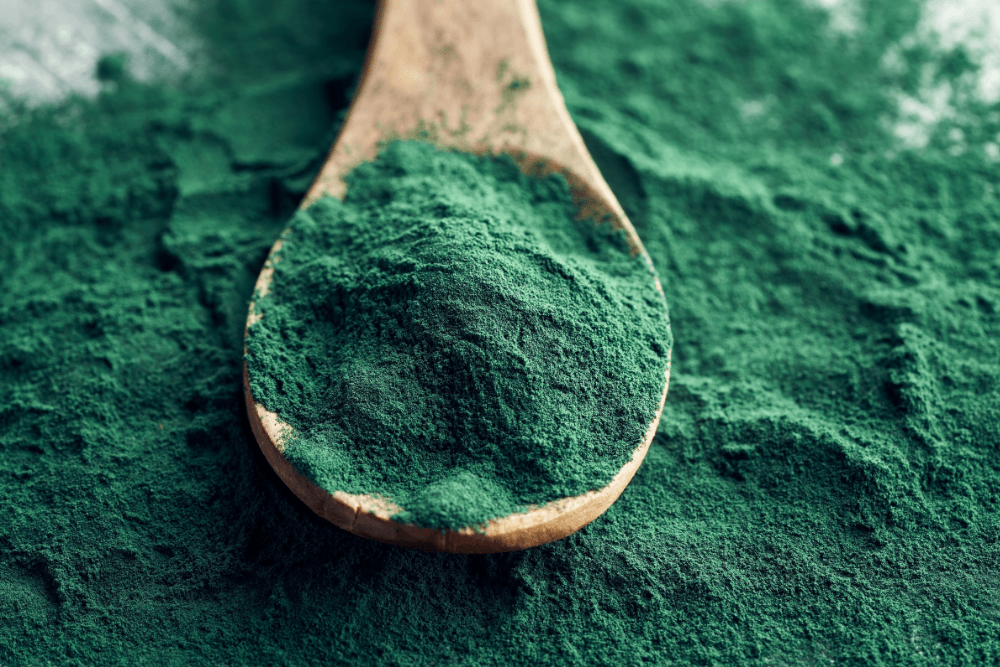
There’s a food the Aztecs harvested from the surface of their lakes five centuries ago, dried into cakes, and prized so highly they called it “the food of the gods.”
It’s a deep blue-green algae, and after decades of modern research, it has become one of the most-studied natural foods on the planet.
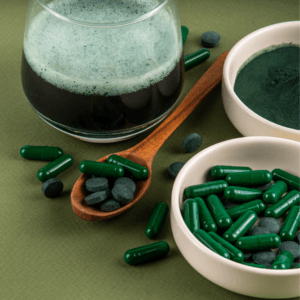 You know it as spirulina.
Now, I’ll be honest with you. Spirulina has been around the health world long enough that it’s easy to dismiss it as “old news.” But here’s what most people never learned: nearly everything researchers find so interesting about spirulina traces back to a single, remarkable compound inside it, a brilliant blue pigment called phycocyanin.
Once you understand what phycocyanin does, a lot of scattered claims about this algae suddenly click into place.
So let’s keep it simple. Below are seven of spirulina’s most promising, research-backed benefits, starting with the one most people are chasing today.
However, please note that I will also share an important caution with you, because there’s a look-alike “blue” trend right now that is not the same thing, and the difference genuinely matters.
The 7 Top Health Benefits of Spirulina
1. Natural, Steady Energy (Without the Crash)
 If your energy isn’t what it used to be, you’re not imagining it. Somewhere in your thirties and forties, the boundless energy of your younger years starts to fade, and most of us reach for the same short-term fixes: another coffee, an energy drink, or a sugary snack.
The trouble is, those “fixes” just borrow energy from later and make you pay it back with interest (an afternoon crash).
Spirulina works differently. It’s a genuinely nutrient-dense food rich in iron and B-family nutrients your body uses to turn food into usable cellular energy. Its phycocyanin is an electron donor, part of the same fundamental chemistry your cells rely on to produce energy every second of the day.
The clearest human signal so far is around mental stamina. Preliminary clinical research on spirulina and brain health suggests it may help reduce mental fatigue and support the health of the blood vessels that feed the brain.
So this isn’t a stimulant “spike.” It’s nutritional support for the systems that make your energy in the first place, which is a very different and more sustainable approach.
2. It’s One of Nature’s Most Powerful Antioxidants Thanks to Phycocyanin
This is the benefit that everything else is built on.
Phycocyanin is the deep-blue pigment-protein concentrated in spirulina. In the algae’s own life, its job is to capture light and donate electrons. In your body, that same chemistry makes it a potent scavenger of the free radicals that drive oxidative stress, one of the core processes behind how we age.
Research suggests phycocyanin doesn’t just neutralize free radicals directly. It may also help activate your body’s own master antioxidant defense system, known as the Nrf2 pathway, essentially helping your cells turn up their internal protection.
Here’s the key takeaway, and it’s the throughline for this entire article: when you read about spirulina supporting your heart, your energy, your skin, or your immune system, phycocyanin is very likely the reason. Clinical research keeps pointing back to this one blue pigment as spirulina’s active star.
That’s also why how spirulina is processed matters so much. Phycocyanin is fragile. Heat damages the very thing that makes it work, so the best spirulina extracts are dried at low temperatures to keep that active blue pigment intact.
3. Healthy Cholesterol and Triglyceride Levels
This is one of spirulina’s most robustly studied benefits, and the evidence is genuinely impressive.
A meta-analysis that pooled seven randomized controlled trials and found that spirulina supplementation was associated with meaningful reductions in total cholesterol, LDL (“bad”) cholesterol, and triglycerides, while also nudging up HDL (“good”) cholesterol.
Later and larger reviews have revealed the pattern: spirulina may support a healthier lipid profile, which is one of the pillars of long-term cardiovascular wellness.
To be clear, spirulina is not a medication and isn’t a substitute for one. However, as a daily nutritional habit, the research suggests it may provide powerful support for healthy cholesterol and triglyceride levels.
4. Healthy Blood Pressure
 Staying with the heart for a moment, because this one’s closely related.
A meta-analysis of five randomized controlled trials found that spirulina supplementation was associated with reductions in both systolic and diastolic blood pressure, with the effect most noticeable in people whose readings were elevated to begin with.
Researchers believe part of the mechanism may involve nitric oxide, a signaling molecule that helps blood vessels relax. It’s another example of spirulina appearing to support the body’s own systems rather than forcing an effect.
As always, if you’re managing your blood pressure, this is a conversation to have with your doctor.
5. Balanced Blood Sugar and Metabolic Health
The research here is earlier and less consistent than the cholesterol findings, so I’ll keep this appropriately measured.
Several studies exploring spirulina in people with metabolic concerns have reported improvements in markers like fasting blood sugar and insulin sensitivity, often alongside the lipid improvements above. It’s part of why spirulina keeps coming up in the broader conversation about metabolic and cardiometabolic health.
The honest summary: spirulina might support healthy blood sugar as part of an overall healthy lifestyle, but this is an area where researchers are still building the picture. It’s promising, but not yet settled.
6. Balance the Immune System and Ease Seasonal Discomfort
 Spirulina has a long history of being studied for its effect on immune function. It was even used by NASA as a dietary supplement for astronauts.
One of the more interesting human findings involves seasonal allergies. In randomized, placebo-controlled research, spirulina significantly lowered levels of IL-4 (a key driver of allergic response) and helped ease symptoms of allergic rhinitis, such as sneezing, congestion, and runny nose, that many people fight each spring.
More broadly, phycocyanin’s anti-inflammatory and immune-modulating activity may help the immune system respond in a more balanced way: calming when it’s overreacting, supporting when it’s needed.
7. Healthier, More Resilient Skin
As a skin health nut, I’d be remiss not to mention what spirulina may do for the body’s largest organ.
Because phycocyanin is such a strong antioxidant, researchers have studied spirulina for its ability to help protect skin cells from oxidative and UV-related stress, two of the biggest drivers of visible aging. Its bioactive compounds have been explored for supporting skin hydration and a healthier, more resilient complexion.
It’s the same logic as the rest of this list: protect the cell, and you support how it looks and functions over time.
The Important Caution: Spirulina’s Blue Is Not “Methylene Blue”
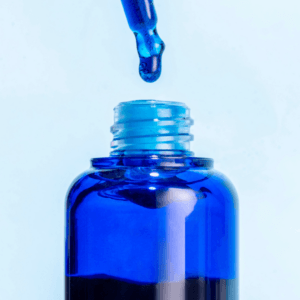 Now for the caution I promised, and please read this part carefully, because the names and the color cause real confusion.
Right now, there’s a trend of people putting drops of a bright, electric-blue liquid under their tongues for “energy” and “focus.” There’s even been an SNL skit about it. That substance is methylene blue, and despite the similar color, it has nothing to do with the natural blue in spirulina.
Here’s the difference that matters:
- Methylene blue is a synthetic dye and a pharmaceutical compound. It is FDA-approved as a prescription drug for one rare blood condition (methemoglobinemia), and it is not approved for sale as a dietary supplement.
- It acts as a monoamine oxidase inhibitor (MAOI), which means it can interact dangerously with a whole class of common antidepressants (SSRIs and SNRIs), potentially triggering a serious condition called serotonin syndrome. The FDA issued a formal safety communication about exactly this risk.
- It can also be a concern for people with G6PD deficiency, and it famously stains the tongue, mouth, and urine blue.
In other words: millions of people are self-dosing an unapproved industrial dye to chase a benefit they could pursue in a completely different and food-derived way.
Spirulina’s blue is not that. Spirulina’s blue color comes from phycocyanin, a pigment-protein found in a food humans have eaten for centuries. It shares methylene blue’s color. It does not share its pharmaceutical risks. That’s the whole point of the “food of the gods” story. The natural blue was here long before the synthetic one.
So if you’ve been curious about the “blue” trend, this is the important distinction to walk away with.
But One Ingredient Is Rarely the Whole Answer
Here’s the part that most spirulina articles miss (and it’s the difference between wasting your money and a formula that actually delivers).
Phycocyanin can only do its job if your cells can use the raw materials around it. And that depends heavily on a few supporting nutrients that quietly make everything else work.
Your B vitamins have to be in a form your body can actually use. This is where a huge number of supplements fail people. Most B-complex products use cheap, synthetic forms like synthetic folic acid and cyanocobalamin for B12 that a large share of the population simply can’t convert well.
In fact, roughly 40% of people carry an MTHFR gene variant that makes them poor converters of these synthetic forms. They take their daily B-complex, barely convert it, and feel almost nothing. The fix is to use the active, methylated forms such as L-5-MTHF folate and methylcobalamin that your cells can use immediately, no conversion required.
Your NAD+ needs support, too. NAD+ is the coenzyme that powers your cellular “energy engines,” and it declines steadily as we age. A nutrient in the B3 family called nicotinamide acts as a direct precursor: a building block your body uses to replenish NAD+.
When you put those cofactors alongside spirulina’s phycocyanin, you get something far more complete than a plain blue algae pill: the star ingredient, plus the supporting cast that lets your body actually put it to work.
My Top Recommendation: MethylateBLUE by Regenerate
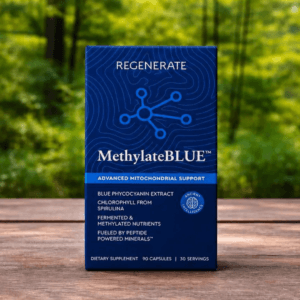 This is exactly the thinking behind MethylateBLUE™, a formula created by Sayer Ji, founder of the natural-health research library GreenMedInfo, that I now personally use.
What I appreciate about it (and why it fits everything above) is that it doesn’t just lean on spirulina. It uses spirulina three different ways:
- A clinical 500 mg dose of organic blue phycocyanin extract, low-temperature dried to protect that fragile active pigment.
- Chlorophyll drawn from spirulina, phycocyanin’s natural green partner pigment.
- Nine essential minerals bound to spirulina-derived peptides, designed to carry them where your cells actually need them.
Then it adds the supporting cast we just discussed: the four active, methylated B-vitamins (no folic acid, no cyanocobalamin) and a fermented NAD+ precursor.
It’s a food-derived, no-prescription, no-blue-tongue way to support the same cellular energy and antioxidant systems people are chasing with that little dropper bottle, but built around the natural “food of the gods” instead of a synthetic dye.
Plus, it’s backed by a 30-day happiness guarantee, so you can try it risk-free.
Very interesting and informative
good to know thanks for sharing 🙂